

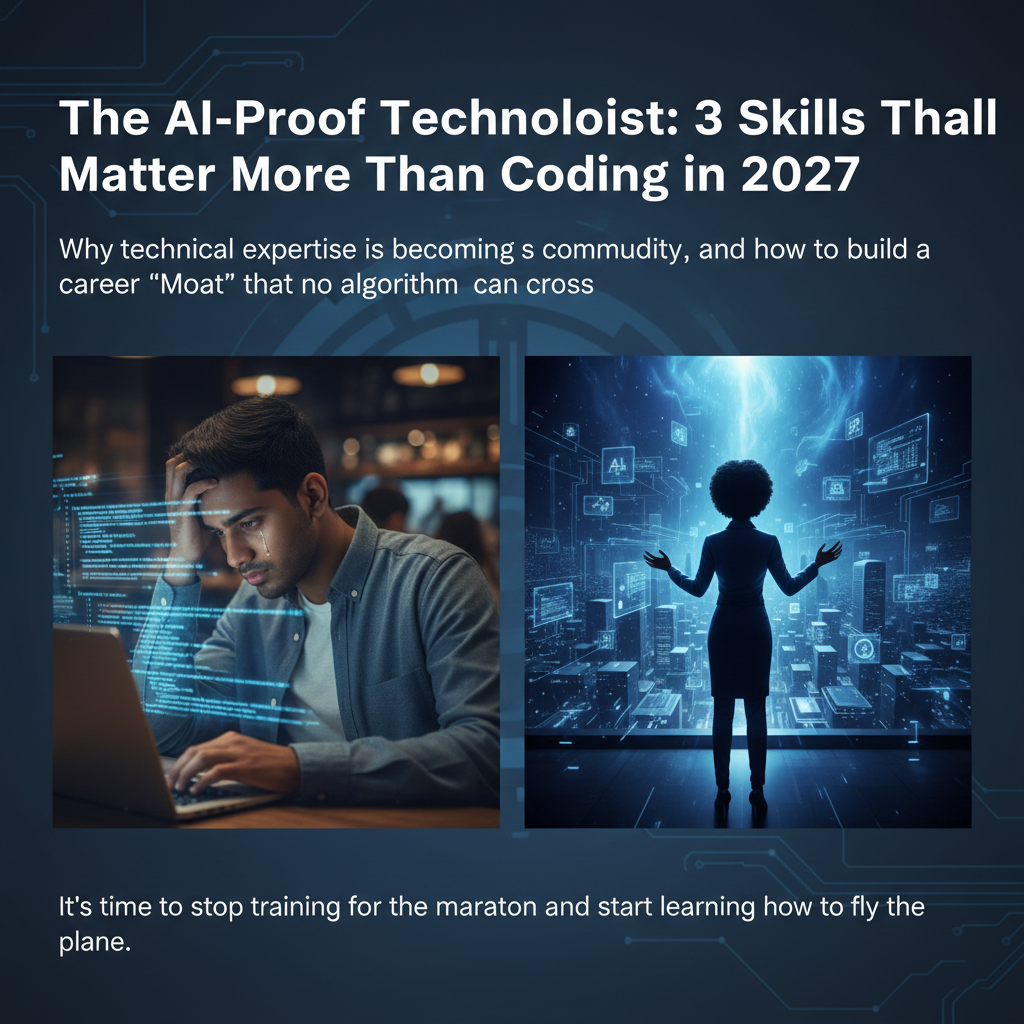
Why technical expertise is becoming a commodity, and how to build a career “Moat” that no algorithm can cross.
The Day the Junior Developer Cried
I was sitting in a coffee shop last month when I overheard a conversation that broke my heart. A junior developer, probably 22 years old, was staring at his laptop, shoulders slumped. He looked at his friend and said, “What’s the point? I just spent four years learning to master React and Python, and now an agentic bot just refactored our entire legacy codebase in six minutes. Better than I ever could. I feel like I trained for a marathon only to find out everyone’s getting airlifted to the finish line.”
He wasn’t wrong. If your value is purely “writing code” or “organizing data,” you are in a race to the bottom against a machine that doesn’t sleep, doesn’t get bored, and costs $20 a month.
But here is the secret I wish I could have told him: AI is not the end of the technologist; it is the end of the ‘Task-Doer.’ In 2026, we are entering the era of the High-Agency Architect. The people who will command the highest salaries and the most influence aren’t the ones who can do the work; they are the ones who can direct the work and contextualize the results.
Here is the 3-skill “Moat” you need to build to become truly AI-proof.
I. Skill #1: Systems Thinking & Orchestration
In the past, we were specialized. You were a “Frontend Developer” or a “Database Admin.” You lived in your silo.
In 2026, silos are death. AI can handle the siloed work perfectly. Your value now lies in Systems Thinking—the ability to see how the cloud infrastructure, the AI agents, and the business goals all interconnect.
From Coder to Orchestrator
Think of a conductor in an orchestra. The conductor doesn’t play the violin better than the first chair. They don’t play the trumpet better than the soloist. Their value is in the Synthesis. They understand how the whole piece should sound.
How to build this:
- Study Architecture over Syntax: Don’t learn a new language; learn how distributed systems communicate.
- Learn the “Full Stack” of Business: Understand how a line of code affects the company’s bottom line. If you can bridge the gap between “technical debt” and “quarterly profit,” you are untouchable.
II. Skill #2: The “Judgment” Engine (Critical Context)
AI is a “Stochastic Parrot.” It is incredibly good at predicting the next word or the next line of code based on patterns. What it lacks—and what it will always lack—is Context and Judgment.
AI can tell you how to build a bridge, but it can’t tell you if a bridge is the right solution for that specific community’s soul.
The “Human-in-the-Loop” Filter
In 2026, your job is to be the filter. You must look at the output of an AI agent and ask:
- “Is this technically sound but ethically bankrupt?”
- “Does this solve the immediate problem but create a long-term maintenance nightmare?”
- “Does this align with our brand’s human voice?”
Judgment is the only skill that scales with AI. The more the AI does, the more important the “Human Sign-off” becomes.
III. Skill #3: High-Stakes Communication (The “Translation” Layer)
As technology becomes more complex and autonomous, the gap between “The Tech” and “The People” widens. Most executives are now terrified of the systems they are paying for because they don’t understand how they work.
Your career moat is being the Translator. #### The Power of Narrative If you can explain “Agentic AI” to a CEO in a way that makes them feel empowered rather than threatened, you will never be out of a job. If you can explain to a customer why their data is safe in a “Sovereignty-First” cloud model using plain English, you are a unicorn.
The 2026 Career Curriculum:
- Storytelling: Learn how to frame a technical proposal as a narrative.
- Negotiation: Learn how to advocate for resources in an era of “AI efficiency” budget cuts.
- Empathy: Understand the fears of your non-technical colleagues and build bridges, not walls.
IV. The “Anti-Fragile” Career Roadmap (A 5-Step Action Plan)
To reach that 20-minute read depth, let’s get practical. Here is how you spend your next 6 months:
- Month 1: Audit Your Tasks. Identify which 70% of your job can be automated. Don’t hide from it—automate it yourself. Show your boss how you’ve increased your capacity.
- Month 2: Master the Orchestration Tools. Learn how to build and manage AI agents (like LangChain or AutoGPT). Become the “Manager” of the bots.
- Month 3: Deep Dive into Business Finance. Read your company’s annual report. Understand where the money comes from.
- Month 4: Public Learning. Start writing on Medium (like this!). Establish your authority. When you share your “Judgment,” you build a personal brand.
- Month 5: Soft Skill Intensives. Take a public speaking course or a creative writing workshop. These are the “un-automatable” skills.
Conclusion: Don’t Compete with the Machine, Run the Machine
The junior developer in the coffee shop was right about one thing: the old world is gone. The era of being a “highly paid pair of hands” is over.
But the new world is infinitely more exciting. We are moving toward an era where one person, armed with the right “Judgment” and “Orchestration” skills, can do the work of an entire department.
The question isn’t whether AI will take your job. The question is: Will you be the one who owns the architecture, or the one who gets archived?
It’s time to stop training for the marathon and start learning how to fly the plane.
I want to hear from you: What is the one skill you’re betting on to stay relevant over the next five years? Is it something technical, or something deeply human? Let’s brainstorm the future of work in the comments.