

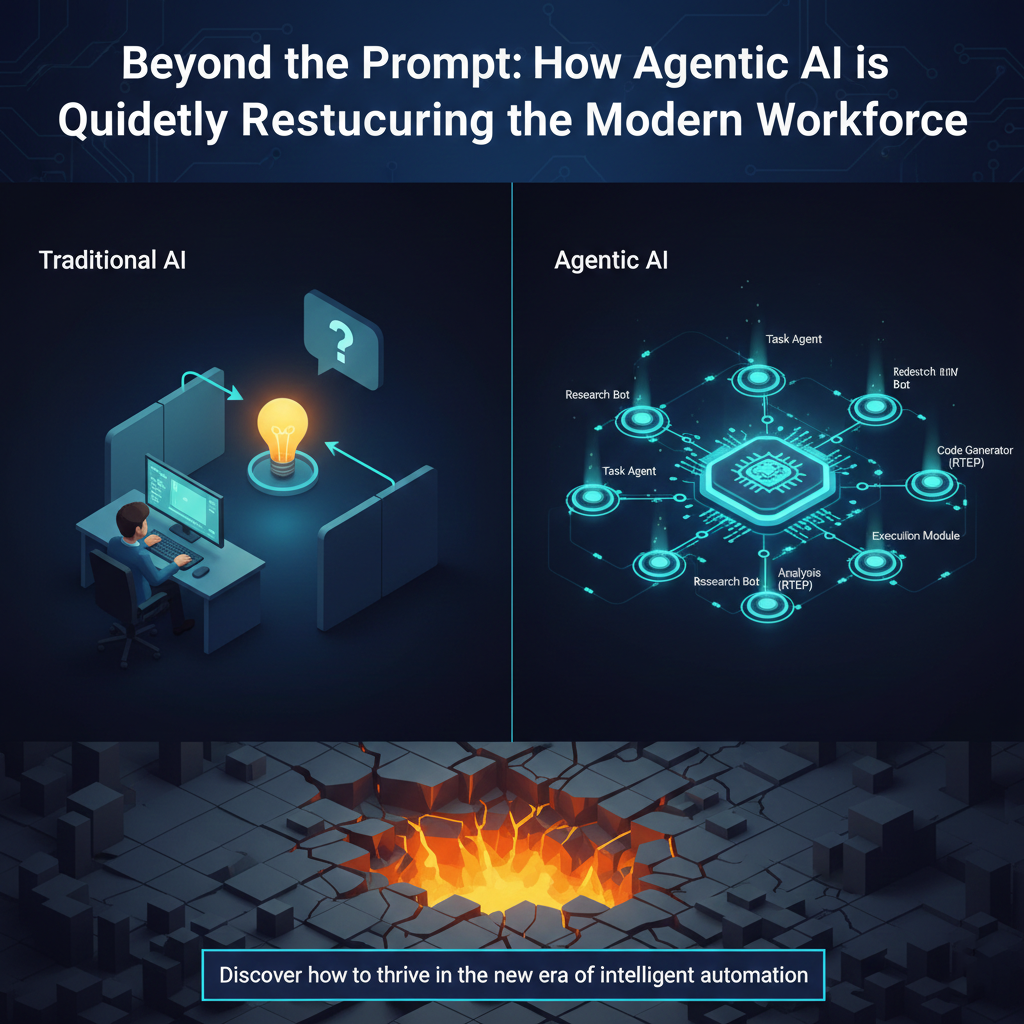
It’s not just about what you ask. It’s about autonomous agents taking action, and why your business (and career) needs a new architecture.
The Inbox That Doesn’t Sleep (And Neither Do I)
Just last week, I woke up to an email at 3:17 AM. Not from a client, not from a colleague, but from an internal “AI Assistant.” The subject line read: “Project X: Supply Chain Anomaly Detected & Corrected.”
My initial thought? Panic. What fresh hell had broken loose?
But as I read on, the panic turned into a cold sweat of awe. This wasn’t just a notification. This AI agent, without a single human prompt in the middle of the night, had:
- Monitored real-time global shipping data.
- Identified a potential port strike in Rotterdam impacting a critical component.
- Cross-referenced inventory with alternative suppliers.
- Initiated a reroute order with a backup vendor in Vietnam.
- Updated the project timeline and notified the relevant logistics team.
All before my first cup of coffee. This wasn’t ChatGPT answering a question. This was Agentic AI taking autonomous action, solving a complex problem end-to-end. And if you’re still thinking AI is just about clever prompts, you’re missing the quiet revolution restructuring every industry.
I. The Prompt Engineering Paradox: Why Humans Are the Bottleneck
Remember 2023? The “Prompt Engineer” was the hottest new job title. People believed that mastering the art of asking AI the right questions was the key. We saw endless guides on crafting the perfect prompt for DALL-E or GPT-4.
But here’s the paradox: if you have to continuously prompt an AI, then you are still the bottleneck. Your time, your attention, your cognitive load is still central to the process. True automation, true digital transformation, doesn’t happen by making humans better at talking to machines; it happens when machines learn to talk to each other and act on their own.
The “Task vs. Goal” Divide
- Traditional AI (Prompt-based): You give it a task (“Write a blog post about Agentic AI.”). It completes the task and waits for the next.
- Agentic AI (Goal-driven): You give it a goal (“Ensure Project X’s supply chain remains uninterrupted.”) It breaks down the goal into sub-tasks, executes them, learns from failures, and iterates until the goal is met. It orchestrates its own actions.
II. What is Agentic AI (Beyond the Hype)?
Think of Agentic AI as a digital employee that doesn’t just process information, but actively reasons, plans, and executes. It’s about giving AI autonomy within defined guardrails to achieve a strategic objective.
The Core Components of an Agentic System:
- Perception Module: Gathers information from its environment (databases, APIs, web scraping, real-time feeds).
- Planning Module: Breaks down the given goal into a sequence of actionable steps. It can even self-correct its plan.
- Execution Module: Interfaces with other tools, APIs, and systems to perform the planned actions.
- Memory/Learning Module: Retains context from past interactions and outcomes, allowing it to improve over time.
- Reflection Module: Critically evaluates its own performance and adjusts future strategies.
This isn’t just a chatbot with a fancy plugin. It’s a sophisticated, self-directing system designed for complex, multi-step operations.
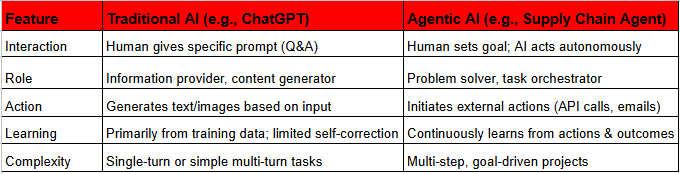
Agentic AI vs. Traditional AI: A Visual Breakdown
To illustrate, consider this simplified view:
III. The Quiet Restructuring: Where Agentic AI is Impacting Business (Right Now)
Agentic AI isn’t science fiction. It’s already here, discreetly transforming industries in critical, high-value areas.
1. Autonomous Operations & IT
- Scenario: A network monitoring agent detects unusual traffic patterns. Instead of just alerting an engineer, it automatically quarantines suspicious IPs, reroutes traffic, and then generates a detailed incident report for human review.
- Impact: Reduces downtime, frees up IT staff for strategic projects, and proactively mitigates threats.
2. Advanced Customer Service & Sales
- Scenario: A sales agent monitors customer behavior across your website and CRM. When a customer shows high intent for a specific product, the agent automatically crafts a personalized email, schedules a demo, and even pre-fills the CRM with relevant details.
- Impact: Hyper-personalized customer journeys, increased conversion rates, and reduced sales cycle times.
3. Strategic Research & Development
- Scenario: A research agent is given a goal: “Find novel applications for quantum computing in renewable energy.” It autonomously scours academic papers, patent databases, and news articles, synthesizes key findings, and presents a summarized report with potential new product ideas.
- Impact: Accelerates innovation, identifies market opportunities faster, and automates mundane research tasks.
4. The Human-Agent Teaming Paradigm
The goal isn’t to replace humans entirely, but to augment them dramatically. Imagine a marketing team where agents handle all the A/B testing, content scheduling, and performance reporting, leaving the humans free to focus on creative strategy and brand vision. This is the new “co-pilot” model—but with a co-pilot that can fly the plane on its own for extended periods.
IV. Navigating the Agentic Future: What This Means for Your Career
The rise of Agentic AI isn’t a threat to human jobs; it’s a redefinition of value. The skills that will matter are shifting dramatically.
- From “Executor” to “Orchestrator”: Your job won’t be to perform tasks, but to design the goals for your AI agents and orchestrate their work. You’ll need to think systemically, not just linearly.
- Ethical AI Design: As agents gain autonomy, understanding and implementing ethical AI principles becomes paramount. How do you design an agent that can’t go rogue, or one that makes fair, unbiased decisions? This is a critical skill.
- “Sense-Making” is King: When agents generate vast amounts of data and actions, the human role becomes that of the ultimate “sense-maker”—interpreting the output, understanding the implications, and course-correcting at a high level.
- Interdisciplinary Collaboration: Agentic AI touches every department. The ability to speak the language of engineering, business strategy, and ethics will make you invaluable.
The prompt engineer of 2023 becomes the Agent Architect of 2026.
Conclusion: The Invisible Revolution
The most profound technological shifts rarely announce themselves with fanfare. They quietly integrate, becoming the invisible infrastructure that underpins everything. Agentic AI is one such revolution. It’s not about the flashy new chatbot; it’s about the autonomous intelligence working tirelessly behind the scenes, optimizing, anticipating, and acting.
Your challenge, and your opportunity, is to look beyond the prompt. To understand that the future isn’t just about asking intelligent questions, but about building intelligent systems that can answer them with decisive action.
Are you preparing your business and your career for an workforce where your colleagues might be autonomous agents? The conversation starts now.
I want to hear from you: What’s the most complex, multi-step task in your current role that you wish an Agentic AI could handle autonomously? Share your thoughts below – let’s explore the possibilities!